

Brain-fog at a Glance:
“Brain-fog” is a commonly used term to describe a feeling of sluggish thinking, difficulty retrieving words or general forgetfulness, trouble focusing on a task or conversation, and slow processing - all aggravated by multi-tasking.
In this article we cover:
Conditions that cause or contribute to brain-fog
Commonly ordered blood tests and functional testing
Naturopathic treatment approach
Exploring Research - Special Topics:
1/ Cognitive Decline and Dementia
2/ Chemo-Brain or Chemo-Fog in Cancer Patients


Licensed Naturopathic Doctor
Your Naturopathic Doctor will provide a thorough investigation to diagnose what’s underlying your brain fog. Some of the commonly associated conditions that we assess for include:
Vitamin B12 Deficiency
Vitamin D Deficiency
Magnesium Deficiency
Iron Deficiency
Anemia
Blood Sugar Issues
Insomnia, sleep deprivation, chronic stress
Inflammation - from Liver, Digestive, or Metabolic dysfunction
Thyroid conditions such as Hashimoto’s Thyroiditis, Hyperthyroidism, and Subclinical Hypothyroidism.
Autoimmune Diseases (like Lupus), Chronic Fatigue Syndrome (ME/CFS), or Fibromyalgia
Perimenopause or Menopause - sex hormone changes such as fluctuating or declining estrogen, as well as altered cortisol and testosterone - all of which affect neurotransmitters (chemical messengers in the brain that affect memory, focus, mood, motivation, and reward).
Gut-Brain Connection - Compromised gut barrier (‘leaky gut’) and food sensitivities
Mitochondrial Dysfunction - when the cells’ mitochondria (the powerhouse of the cell) cannot keep up with energy demands
Environmental Exposures - such as mold toxins (mycotoxins) or heavy metals
Post-viral syndromes - such as long-COVID
Dementia and Cognitive Decline - a consultation with a specialist will be recommended to provide a diagnosis if this is suspected.
Testing has a critical role to providing a clear diagnosis. Here are some of the tests that may be ordered by your Naturopathic Doctor depending on your presenting symptoms:
Conventional Blood Testing:Nutrition & Routine Bloodwork: Iron panel or Ferritin, Vitamin B12, RBC Magnesium, Vitamin D, CBC with differential, Liver and Kidney function tests, and electrolytes.
Enhanced Thyroid Assessment: FT3, FT4, TSH, TPO, Reverse T3, ATG.
Cardiovascular & Inflammatory Markers: hsCRP, Homocysteine, lipids, and Apolipoproteins.
Metabolic Assessment: Fasting glucose and insulin, HbA1c.
Functional Medicine Testing:Comprehensive Stool Analysis
4-Point Salivary or Urinary Cortisol to assess your adrenals
Organic Acids Test (OAT)
Heavy Metals Screening
A sleep study may also be recommended to assess for Sleep Apnea, which is a sleep disorder where a person repeatedly stops breathing throughout the night (due to relaxation of the throat muscles blocking the airway). This leads to loud snoring, possible gasping, severe daytime fatigue, and many times brain fog.
An Integrative approach working cooperatively with your family doctor or specialist is central to getting you a clear diagnosis, especially in cases where early cognitive decline, dementia, liver disease, or malignancy is suspected.
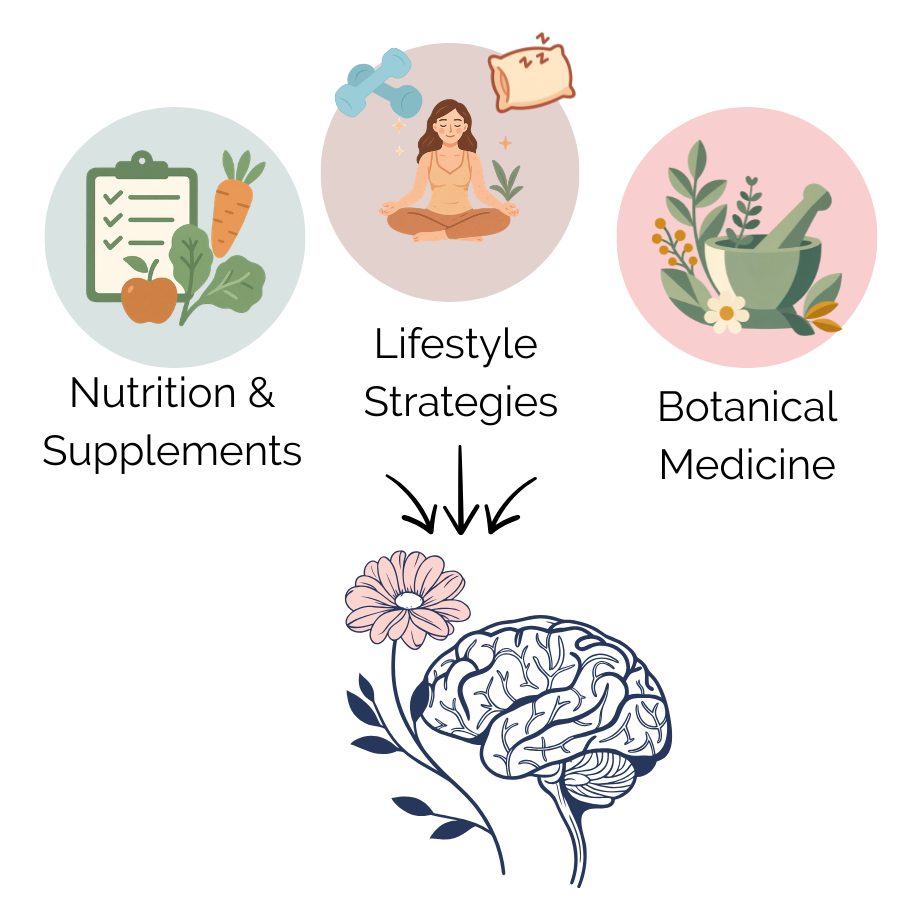
—> Naturopathic Treatments are multi-faceted and include the following:
Holistic dietary recommendations tailored for your nutritional needs, preferences, and food sensitivities.
Lifestyle tools to support improved stress management, nervous system regulation, routines and rhythms, and sleep.
Botanical medicine and supplementation to target the root causes uncovered from comprehensive testing and symptom analysis.
While the bulk of the assessment is done at the first and second visits, we build your treatment plan in stages ensuring safety and effectiveness by monitoring your response as you go.
As we look to the future, we know that your health is ever-evolving and as a part of your healthcare team our goal is to protect your vitality and quality of life long-term. Once you have achieved your initial goals we are here for annual check-ups to make sure you are being followed properly.
Exploring Research: Special Topics
1/ Cognitive Decline and Dementia
2/ Chemo-Brain or Chemo-Fog in Cancer Patients

1/ Cognitive Decline and Dementia:
Advanced age is the main risk factor for dementia and cognitive impairment, followed by genetic, socioeconomic, and environmental factors - in particular, nutrition, physical activity, diabetes, obesity, smoking, hypertension, sleep disturbance, and social isolation are among the top potentially modifiable factors (1).
The Finnish Geriatric Intervention Study to Prevent Cognitive Impairment and Disability (FINGER)
According to a 2-year randomized control trial (RCT) studying 1260 at-risk older adults, aged 60-77 years, a multi-pronged, holistic approach has the best outcomes. Here are the top prevention strategies of Age-Related Cognitive Decline and Dementia identified by this study (1):
Traditional, whole foods diets that are cardio-protective, such as the Mediterranean-style Diet, Traditional Japanese Diet, Nordic Diet and the DASH diet
Exercise - combining aerobic and resistance training improves memory and executive function, increases cerebral blood flow and lowers overall dementia risk
Cognitive training
Social activities
Vascular and metabolic risk factor monitoring and management
The results of combining these strategies into a whole lifestyle shift is greater than the sum of its parts (1):
25% more improvement in global cognition,
83% more in executive function,
150% more in processing speed, and
40% more in complex memory than control advice.
Improved BMI scores
Just as in the study, a multi-practitioner healthcare team can make all the difference in implementing these strategies and monitoring your progress.
2/ Chemo-Brain or Chemo-Fog in Cancer Patients:
“More than 75% of patients with breast cancer treated with chemotherapy experience cognitive impairments (eg, memory and attention problems), commonly known as chemo-brain (2).”
During chemotherapy many brain changes can take place depending on the particular regimen you are given. A majority of patients experience some degree of what is commonly known as ‘chemo brain’ or ‘chemo fog’, which feels much like thinking through molasses. Symptoms such as difficulty focusing, memory loss, slower thinking, and confusion can be unsettling and affect your day to day functioning.
Daily physical activity such as walking or swimming can be a game changer.
According to a 2021 study led by Dr. Michelle C. Janelsins and published in the Journal of Clinical Oncology, exercising during breast cancer treatment helps preserve mental sharpness. Women with breast cancer (stages I-IIC were included) who achieved standard weekly physical activity goals before and during treatment had better cognitive function when chemotherapy was done and 6 months after when compared to inactive patients (3). Any kind of exercise is great, especially when it is kept within a regular routine (daily is better than once weekly). Aerobic high-intensity interval training (HIIT) may be something to work towards over the long-term and only when your body is ready - working with a physiotherapist experienced in oncology care is important, because we also know that pushing too hard too soon can set you back with increased fatigue and pain. You will also want to be cleared for exercise by your oncologist as they know your state of health best.
If you have any questions about this article’s topic please feel free to email us at info@wnhn.ca for more information.
References
Dominguez LJ, Veronese N, Vernuccio L, Catanese G, Inzerillo F, Salemi G, Barbagallo M. Nutrition, Physical Activity, and Other Lifestyle Factors in the Prevention of Cognitive Decline and Dementia. Nutrients. 2021 Nov 15;13(11):4080. doi: 10.3390/nu13114080. PMID: 34836334; PMCID: PMC8624903.
Wilson R, Kang DW, Tahbaz M, Norris M, Uno H, Ligibel J, Guenette J, Christopher C, Dieli-Conwright C. Improving Cognitive Function Through High-Intensity Interval Training in Breast Cancer Patients Undergoing Chemotherapy: Protocol for a Randomized Controlled Trial. JMIR Res Protoc. 2023 Apr 7;12:e39740. doi: 10.2196/39740. PMID: 37027186; PMCID: PMC10132015.
Salerno EA, Culakova E, Kleckner AS, Heckler CE, Lin PJ, Matthews CE, Conlin A, Weiselberg L, Mitchell J, Mustian KM, Janelsins MC. Physical Activity Patterns and Relationships With Cognitive Function in Patients With Breast Cancer Before, During, and After Chemotherapy in a Prospective, Nationwide Study. J Clin Oncol. 2021 Oct 10;39(29):3283-3292. doi: 10.1200/JCO.20.03514. Epub 2021 Aug 18. PMID: 34406822; PMCID: PMC8500586.